Forex for beginners in 2026
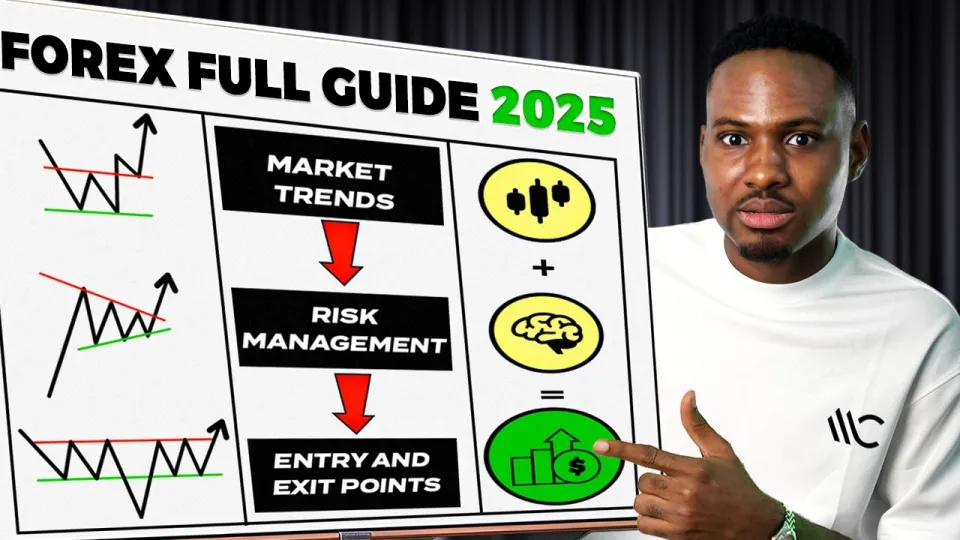
Video: How To Start Forex Trading For Beginners’ 2025 (Full Course)
Want articles like this for your own video to promote it on YouTube and Google? Order them through the Telegram bot @sat_sit_bot. It writes articles around your video, embeds the video and publishes them on popular niche websites (no ads). Free trial — 50 articles.
Key takeaways
- A beginner forex course covers market structure, tools, a first trade and risk rules; copy-trading signals skip the learning step.
- Jeffrey Benson Forex structures the full course in seven blocks, from "What is forex" to common beginner mistakes.
- Four sessions (Sydney, Tokyo, London, New York) set liquidity; London–New York overlap is the busiest window.
- MT5 is the standard terminal in the course workflow: broker account, platform link, funded balance, then trades.
- Demo trading with written notes beats watching video without practice, a point viewers keep repeating.
Forex for beginners is best started with a structured full course rather than a signal channel, because a course teaches position sizing, risk per trade and platform mechanics before real money is at stake. The free full course from Jeffrey Benson Forex walks through seven blocks — what forex is, how the market works, the tools you need, a basic strategy foundation, a first trade, and the mistakes to avoid. Students who want the author's own curriculum and mentorship can see the plans on firepipsfx.com.
What forex trading actually is and why beginners need a course
Forex is the market where national currencies are priced against each other in pairs, and a beginner needs a course because the mechanics — lots, leverage, spreads, sessions — decide the outcome more than any single prediction. A currency pair such as EUR/USD quotes how many dollars one euro costs; a trader profits if the base currency strengthens after a buy, or weakens after a sell. There is no central exchange: trading runs over the counter through a network of banks, brokers and liquidity providers, which is why broker choice and execution quality matter as much as analysis.
Three facts shape every beginner decision:
- The market is open 24 hours on weekdays, so nobody has to trade at a fixed hour — but liquidity is not equal across the day.
- Leverage multiplies both gains and losses; a 1:100 account turns a 1% price move into a 100% swing on margin, which is why risk per trade is set before entry.
- Costs are embedded: spread, commission and swap on positions held overnight quietly erode a small account.
How the market works: sessions, liquidity and the pairs that move
The forex day is split into four sessions — Sydney, Tokyo, London and New York — and the London–New York overlap is the busiest window, when spreads are tightest and major pairs move most. Sydney opens the week, Tokyo follows, London brings the heaviest volume in EUR/USD and GBP/USD, and New York carries the US data releases. A beginner does not need to watch all four: picking one or two sessions that fit a real schedule produces more consistent attention than trading around the clock.
Pairs are grouped by behaviour. Majors (EUR/USD, USD/JPY, GBP/USD, USD/CHF) carry the lowest spreads and the deepest liquidity. Crosses such as EUR/GBP or AUD/JPY move on two economies at once and are more volatile. Exotics pair a major with a smaller economy and can gap on thin liquidity. For a first account, majors are the practical choice.
Tools a beginner needs before the first trade
The minimum toolkit is a regulated broker account, a trading terminal, a chart with a few clean indicators, an economic calendar and a trading journal. MetaTrader 5 is the terminal used in the course workflow: the broker account is created first, MT5 is downloaded and linked to it, the balance is funded, and only then are trades placed. A demo account on the same platform lets a beginner rehearse every step without risk.
A workable starter setup looks like this:
- Charts: candlesticks on two timeframes — a higher one for direction, a lower one for entry.
- Indicators: one trend tool and one momentum or volatility tool at most; stacked indicators usually cancel each other out.
- Calendar: scheduled rate decisions, CPI and employment reports, because a release can wipe out a technical setup in minutes.
- Journal: entry, exit, reason, risk in pips and result, written down for every trade.
- Risk calculator: position size derived from account balance and stop distance, not from a feeling.
Viewers of the course repeatedly note that writing while watching is what makes the material stick — the sessions, the pair groups and the risk rules are easier to recall from a notebook than from memory.
Strategy foundation: structure, levels and a repeatable setup
A beginner strategy is a fixed set of conditions that decides direction, entry, stop and target before the chart is opened. The foundation is market structure: higher highs and higher lows describe an uptrend, lower highs and lower lows a downtrend, and a range is neither. Support and resistance mark where price previously reversed or accelerated, and those levels give entries a reference point instead of a guess.
A simple, repeatable setup works in four steps:
- Mark the trend on the higher timeframe.
- Wait for price to pull back to a level or a moving average that has already acted as support or resistance.
- Enter only on a confirmation candle, with the stop beyond the level that would invalidate the idea.
- Set the target at the next level, and accept only setups where the reward is at least twice the risk.
Risk per trade is capped before anything else: a common beginner rule is 1% of the account per position, which means a 10-loss streak costs roughly a tenth of the balance rather than the whole account. Position size follows from that number and the stop distance.
Placing a first trade without skipping steps
The first trade is a checklist, not a prediction: confirm the setup, size the position, place the order with a stop loss and take profit, then log the result. On MT5 the sequence is to select the pair, open a new order, set volume in lots, attach stop loss and take profit levels, and confirm. Checking that both protective orders are active before walking away is the step beginners skip most often.
The realistic path is demo first, then a small live account. Demo builds the mechanics — order types, spreads, slippage on news — while a small live balance adds the emotional pressure that demo cannot reproduce. Traders who jump straight to a funded account with oversized lots usually discover risk management the expensive way.
Common beginner mistakes and the questions they raise
The most expensive beginner mistakes are oversized positions, trading without a stop, revenge trading after a loss and switching strategies after two bad trades. Comments under the course show the same doubts repeatedly: whether an hour of video is enough to trade, whether signals can replace learning, and how long the learning phase should last. The honest answers are that the video is a map rather than the territory, that copied signals remove the skill being built, and that a demo phase measured in months, not days, is normal.
Other frequent traps:
- Trading during major news without accounting for spread widening.
- Averaging into a losing position instead of taking the planned loss.
- Measuring progress by one winning trade rather than by a sample of fifty.
- Following several mentors at once and mixing incompatible rules.
Useful links
- Course plans and mentorship: https://firepipsfx.com/plans
- Free daily signal channel: https://t.me/firepipsignals
- Broker registration used in the course: https://my.assexmarkets.com/auth/register?partner_code=1699134
- Premium signal group access: https://t.me/jeffreybenzhelpbot
Bottom line
A full course is the better starting point than a signal feed because it builds the part that survives a losing streak: risk control, platform mechanics and a written process. The Jeffrey Benson Forex beginner course covers that ground in a single sitting, and the next step is practice on demo with a journal open. Once the checklist runs without hesitation, the paid plans at firepipsfx.com offer a structured route into live execution.
Questions & answers
Is one video course enough to start trading forex?
It is enough to understand the mechanics and avoid the classic beginner errors, but not enough to be profitable. Plan on a demo phase measured in months, with a journal, before risking real money on a small live account.
Can I just copy signals instead of learning to trade?
Copying trades skips the skill-building step: you inherit the risk of a position without knowing why it was opened or when it should be closed. Signals are more useful as a reference alongside your own analysis than as a replacement for it.
How much money do I need to start forex trading?
Many brokers accept small deposits, but the amount matters less than position sizing. With a 1% risk rule, a small balance simply means smaller lots; starting on demo costs nothing and teaches the same mechanics.
Which session should a beginner trade?
Pick the session that fits your schedule and offers liquidity — London and the London–New York overlap are the busiest for major pairs. Trading one session consistently beats watching the charts around the clock.
Source: How To Start Forex Trading For Beginners’ 2025 (Full Course) · Markdown version